Combining Strategy Development with Team Development turbo-charges the process and creates a deep level of buy-in and commitment by your leadership team.
The IT Strategy Development workshops (always offsite at a decent hotel venue) that I facilitate for CIOs and their IT leadership teams are rather unique experiences.
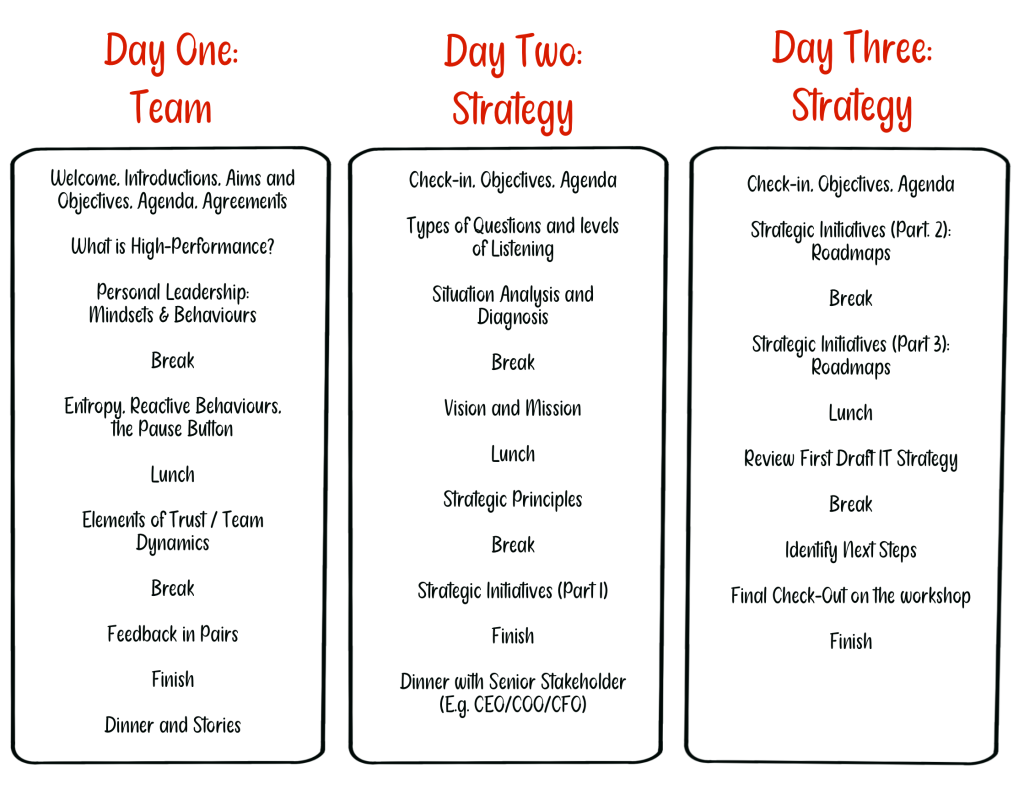
Day One: High-Performance Team Development
The way that we spend the first day focussed on starting to build a high-performance team and develop individual leadership skills means that the strategy conversations that start on day two are materially and self-evidently richer, deeper, and more efficient and effective.
If you don’t spend time on the “people work” before you start talking strategy, your team will bring into the room with them their normal mindsets and behaviours - their normal level of consciousness.
All of their accumulated biases, concerns, reactive behaviours, opinions about their peers, and preconceived ideas about what needs to be fixed.
The conversations won’t be new. They will probably just be rehashes of what has been said before. Any lasting disagreements between team members will still be there. The level of trust will be just the same. The context within which the conversations happen will be the same as it’s always been.
Let me explain why and how that first day focussed on team and leadership development is so important and so powerful.
To start with, the day looks nothing like what you might conceive as “team building” or “motivational speaking”.
Such things might be fun and entertaining, but usually have little lasting impact. That’s not what I do or what this is.
In contrast, imagine a very pleasant meeting room in a decent hotel some distance away from the office. The room is set up with a semi-circle of chairs for the participants. There are no tables in front of the chairs. Up front there’s a screen, four flip-charts, and a large whiteboard. No laptops. No cell phones. There’s very few powerpoint slides.
The first day I guide the team through a series of conversations about their own leadership and team dynamics that are highly experiential and personally insightful.

The individuals will learn things about themselves and their behaviours that they did not know before. They will learn things about their team mates that they did not know before. They will share information about themselves with their peers that they have not shared before. They will get “things off their chest” that they have been holding onto for months or even years. They will learn some basic yet core skills that will help them manage their own mindsets and behaviours when their buttons get pushed. They will give and receive feedback to and from all their colleagues in a safe and simple way.
And critically they will see possibilities for themselves and the team and its performance potential that they could not see before, nor even knew existed.
The first day culminates in a dinner together where we share some personal stories through the medium of playing everyone’s favourite music tracks, have some fun together, and enjoy each others company in a relaxed private dining setting.
You can imagine how an experience like that first day inevitably builds greater self-awareness for all the team members and deepens the level of trust and respect within the team. They have gone through what is purposefully designed to be a very personal journey of self-development - together, in a shared experience. They will remember that day together for a very long time.
Day Two: Strategy Development
The second day starts with a simple check-in on the teams’ reflections and insights from the first day, and sets the objectives and context for the strategy work that comes next.
The strategy development work (over day two and three (maybe four)) has 7 parts to it:
- Situation Analysis and Diagnosis,
- Vision and Mission,
- Strategic Principles,
- Strategic Initiatives,
- Roadmap for the Strategic Initiatives,
- Review the Draft Strategy
- Next steps in the Strategy development process.
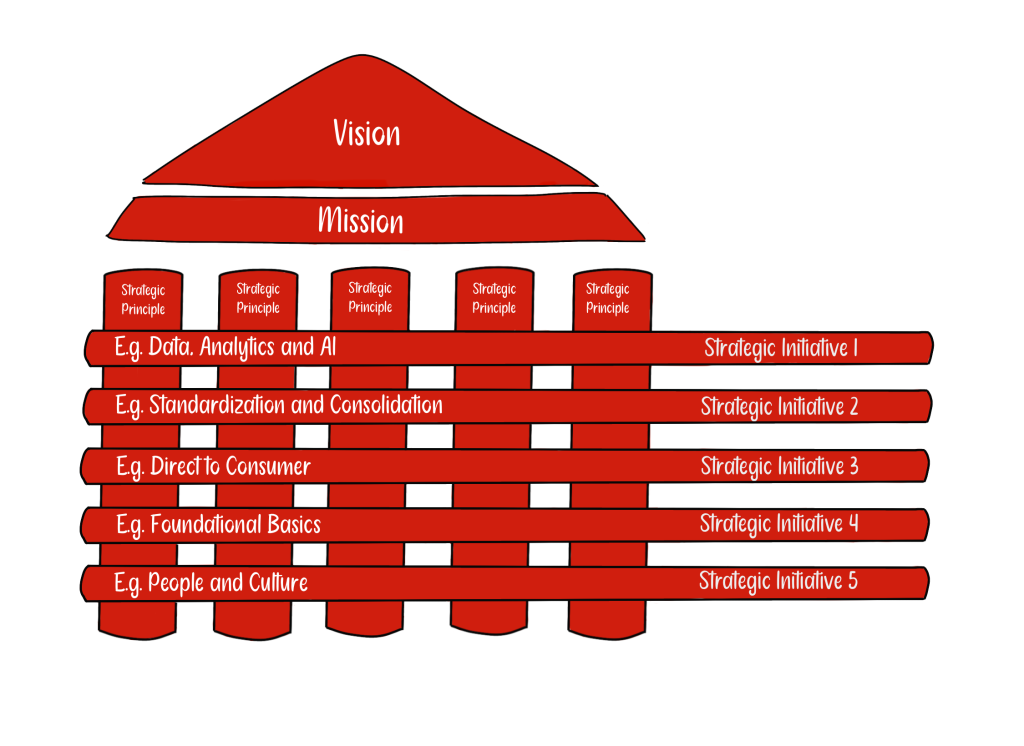
1. Situation Analysis (2 - 3 hours):
Whenever we are developing a strategy for anything, it’s important that we start by detailing out and understanding where we are now. This will include i) Reviewing the last year's performance for the IT Department and identifying “What’s working?” And “What needs improving?”, ii) Some form of SWOT type analysis, iii) Identifying and making explicit the wants / needs of the business and your C-Suite colleagues (as specified in the overarching organisational strategy), and iv) Listing out all of the most important opportunities and new technologies that are emerging in the wider market.
So we will work through those four elements, discuss them in small groups and in plenary, and detail them all out on flip-charts. In working through these initial stages of the situation analysis, you and your leadership team will get to a collective view of what your universe looks like right now. The good, the not so good, and what is possible.
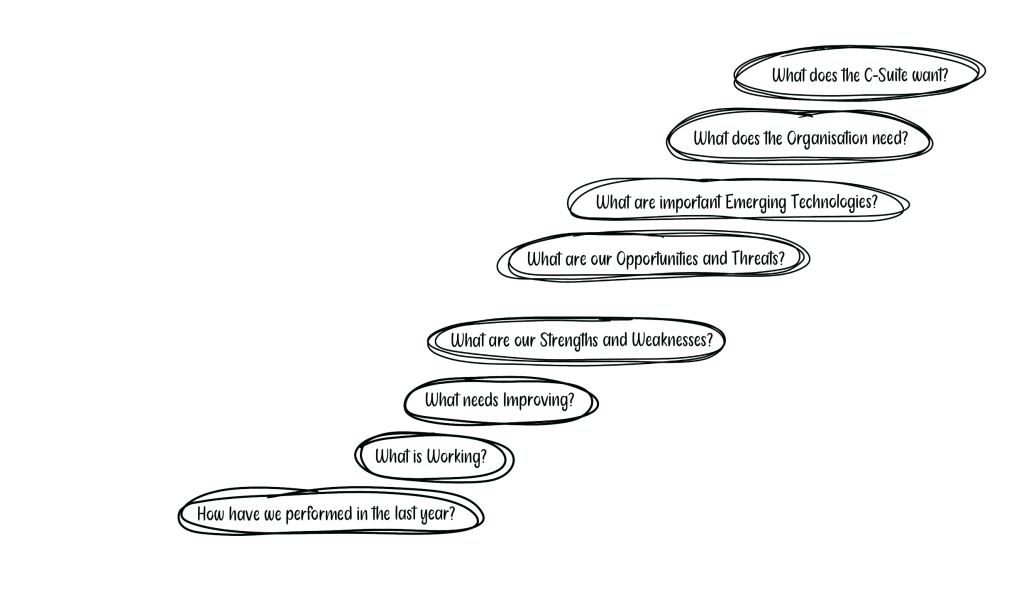
We will then ask ourselves some version of the following questions:
- What are our biggest opportunities and why?
- What are our biggest challenges/risks/problems and why?
- What are the root causes of those things?
- What things/issues are not that important here?
- Where do we have strengths/advantages?
All the different perspectives and perceptions from the team members are surfaced, discussed, and understood. Misperceptions and misunderstandings are cleared up. Everyone is now on the same page!
2. Vision and Mission (1 hour):
Now we have laid out what the current situation looks like for the IT department, we turn our attention to what our destination and purpose is. What it is we are aiming to achieve and what will motivate us to make it happen.
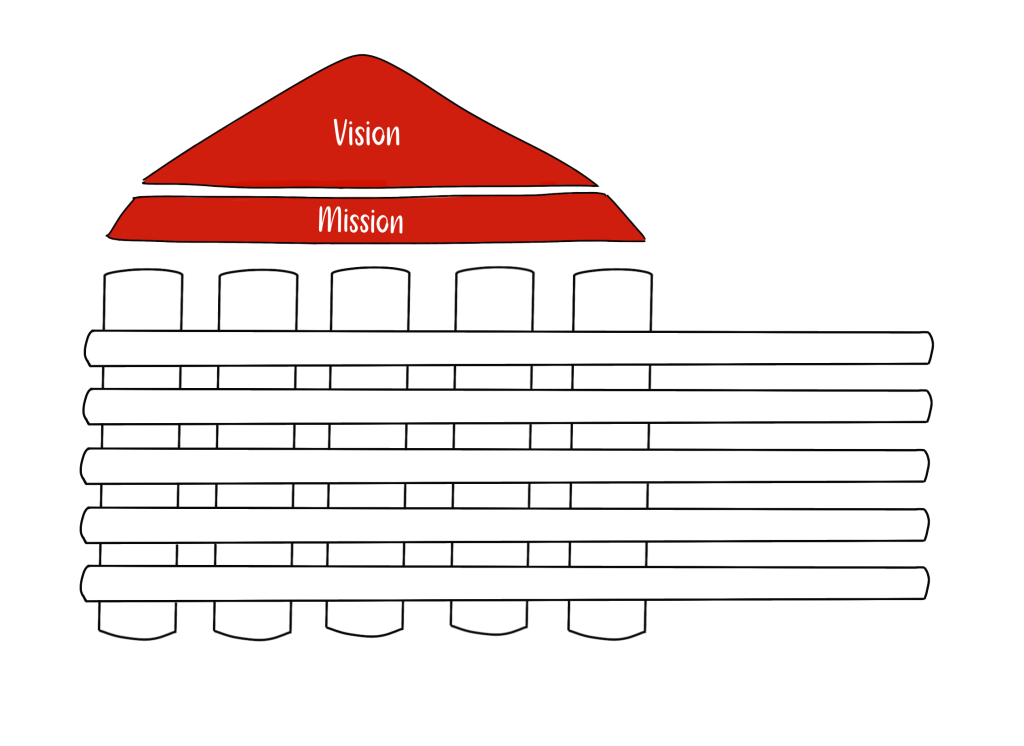
The vision is the end-state that you as a team want to get to by a certain date (usually in 3 years time). It is often a description of what function and value you will be providing for the wider organisation and your customers. It is not what you “do” everyday. It is what you aspire to be.
We will use questions like these to drive the thinking and discussion:
- What is the Big Meaningful outcome that we want to create?
- What Big Result will make us proud to have achieved?
- What Big Difference do we want to make?
- What will we be in 20XX?
Tests for an answer: Is it big? Does it inspire? Will it guide everything we do?
The mission is what motivates you and your team to come to work everyday. It’s a simple statement usually starting with “To…”.
We will use questions like these to help craft the team’s mission statement:
- Why does this team exist? What is our core purpose? What is our Mission?
- Why do we do what we do?
- What motivates us to do what we do?
- What will have us want to go to work?
- Who do we serve and what do we do for them?
Tests for an answer: Will it get us up in the morning? Is it memorable? Will it guide our day-to-day, and week-to-week actions? Could someone see us fulfilling it every day?
To be clear, we will not spend hours and hours developing the Vision and Mission statements. We will start by spending 30 minutes on each. An individual reflection and note taking, a paired conversation, then a plenary conversation where I record everyone’s suggestions on a flip-chart. We will then move onto the next part of the process. In parallel with the work that the team does over the next day/s, I will polish and iterate the vision and mission statements with you the CIO.
3. Strategic Principles (1.5 hours):
The strategic principles are guidelines, themes, and boundaries that will inform all of the work that the IT team does over the next 3 years.
They are not initiatives or projects (those come next). We will brainstorm what they could / should be. Get all the suggestions up on a flip-chart, notice the patterns and main themes, then select what we think are the most important ones that will drive and influence the work going forward. We will then detail them out in terms of what they will look like in practice.
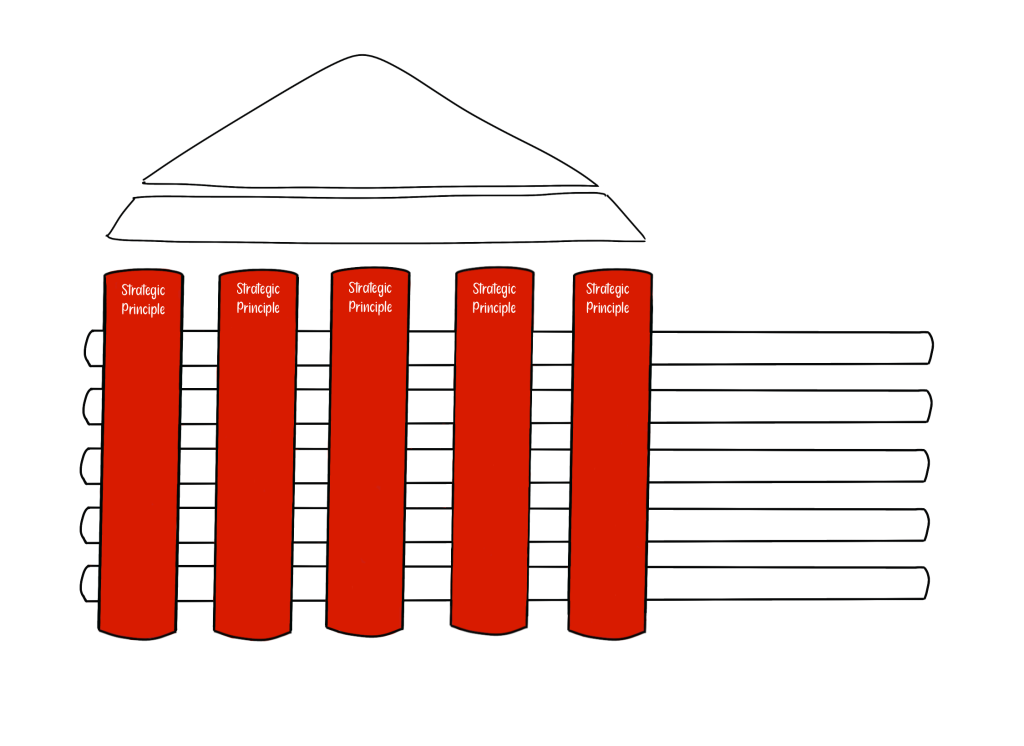
Questions like these will help us identify the Strategic Principles:
- What principles should guide all of our work in the IT Department?
- What themes/threads/flavours will run through all our work?
- What is in scope for our IT Strategy and what is out of scope?
- What will make our IT Strategy distinctive?
- What are the most important foundations of all the work that we do?
Example Strategic Principles that have been developed by other CIO IT leadership teams that I have worked with include: Agile, Innovative, Transformative, Consolidation, Excellence, Business Partners, Focussed, Simplicity, Customer Centric, and Fit for Purpose.
4. Strategic Initiatives (1.5 hours):
We will now turn our attention to identifying the most important big initiatives that will deliver on our business objectives and vision for the IT department.
These will usually be groups of projects, not individual projects themselves. At this stage we are just identifying what they should be (we will detail them out in the next stage of the process).
We will use some version of the following questions to identify the strategic initiatives:
- What are the 3-5 big initiatives that will deliver what we want?
- What are the 3-5 big groups that all our activities should fall within?
- What big initiatives are currently running? Do they qualify for initiatives in this context at this level, or are they really just projects or things we just need to get done anyway?
- What big new initiatives do we need to launch to help us achieve our vision?
Some of these strategic initiatives will be obvious and in fact may already be happening. For example, many IT leadership teams will be in the process of implementing an organisation wide ERP (Enterprise Resource Planning) system such as SAP or Oracle. The scale of this kind of project almost certainly qualifies it as a strategic initiative.
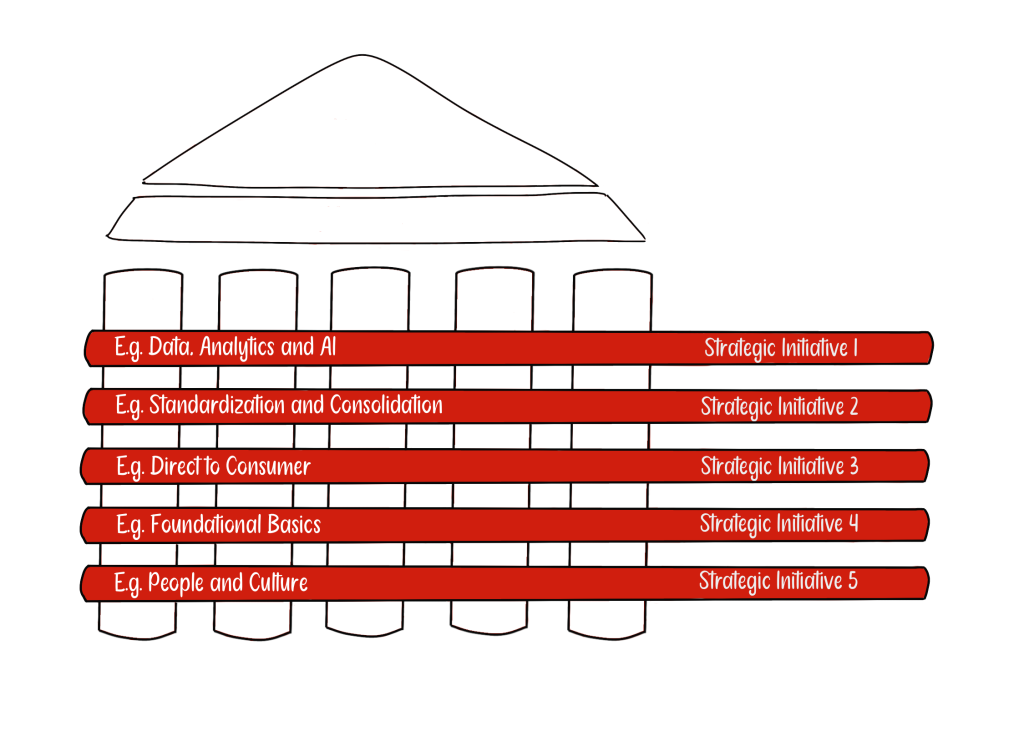
Examples of other strategic initiatives that have been identified and set in motion by IT senior leadership teams that I have worked with include:
- People and Culture - A High-Performance IT Organisation,
- Data and Analytics - Data Driven Decision Making,
- Standardisation and Consolidation - Scalability, Adaptability, and Speed,
- Direct to Consumer - Engaging our Customers,
- Foundation - Strengthen our Core.
Given the recent advances in Artificial Intelligence, it is almost certain that that topic will form part of one of your strategic initiatives, or qualify as one by itself.
So by the end of this stage we will have identified the three, four, or five strategic initiatives that you and your IT leadership team will build out and drive over the next 3 years. The next step in our process is to detail those initiatives out.
Day Three (and Four if available): Strategy Development
5. Roadmap for the Strategic Initiatives:
Now we have identified our strategic initiatives, we need to start on building out the detailed roadmaps for each of them. To clarify, during this particular session during the workshop we will push for as much detail as we can within the time available (usually between 3 and 9 hours depending on whether the workshop is 3 or 4 days duration). There will always be further refining and planning to do with the strategic initiatives after the workshop.
Of course the specific format for the strategic initiative roadmaps can be designed in whatever way is fit for purpose, but with the IT leadership teams that I have worked with, we typically start with the following basic structure.
(Insert image of the Strategic Initiative framework here)
We break into subgroups (carefully choosing which IT leadership team members should be in each subgroup according to their specialism / area that they lead in the department) with each subgroup focusing on one of the strategic initiatives and populating 3 flip-charts each:
- i) The Current State, a list of points that describe where the IT organisation or the wider organisation is with regard to this topic,
- ii) The End-State, a list of descriptors on where the IT organisation or the wider organisation will be on this topic in 3 years time,
- iii) Actions in next 12 months - a list of the potential actions, decisions, and specific pieces of work that could / will be needed to be done to make progress towards that end-state.
After this first pass of populating the 3 pieces of the framework, we rotate the sub-groups so that all team members get to see the work that the other groups have done and add additional details to the flip-charts that they think are relevant.
If we have identified five Strategic Initiatives, we would typically start with the three biggest and most important ones, then move onto the remaining two.
Once the team feels that they have captured all of their input on the flip-charts for the five strategic initiatives, the sub-groups convert all of the notes into powerpoint slides. These slide-decks are consolidated with the other draft strategy slides that include the polished version of the vision and mission statements as well as the strategic pillars with the descriptions of each.
6. Review the Draft Strategy:
Once the draft strategy slide deck is all put together and the team have taken a well earned coffee break, it’s time to sit down and review what has been achieved. We work through all the slides from the strategy development process that we have been through, from our Situation Analysis and Diagnostic, the Vision and Mission, the Strategic Pillars, the Strategic Initiatives, and finally the Roadmaps for those Strategic Initiatives.
This is an opportunity to see if anything is missing, to check that there is a logical flow from where we see things are now, to what we want to build, and to make sure that we have captured most of the actions that need to be taken over the next 12 months on the strategic initiatives.
You and the team will be both amazed at how much progress you have made in just 3 or 4 days and proud of what you have accomplished together.
7. Next steps in the Strategy development process:
The last part of our time together at the workshop is to think about and identify the necessary next steps that need to be taken to add further detail to the Strategy document and to plan the socialisation and iteration process. This inevitably looks like assigning sub-groups with “owners” for each of the strategic initiatives and aligning on dates for when the sub-groups will meet and what extra information needs to be sought.
As the CIO you will be starting to think about who you need to share the draft strategy with and how you will do that to get their feedback and buy-in.
Of course, the new strategic initiatives will need budgeting for, so the CFO for one will want to get a sense of the scale of investment that will be required compared to the potential ROI that you see resulting from what you are planning.
Timewise, you can expect to spend approximately 2 - 3 months in polishing the Strategy Document, and getting commitment and approval from your C-Suite peers. Of course given that you will have probably spoken with each of them as part of the preparation phase before the Strategy Development workshop, your Strategic Initiatives should line up very well with what they will have told you they want and need.
To summarise then…
This 3 or 4 Day workshop experience will improve your IT Senior Leadership Team's collective performance and deliver you the first draft of a very well conceived IT Strategy for your organisation. A strategy that has 100% buy-in and commitment from your leadership team and an in-built alignment with the wider organisation's strategic goals.
CONTACT
Email: contact@antonyshave.com